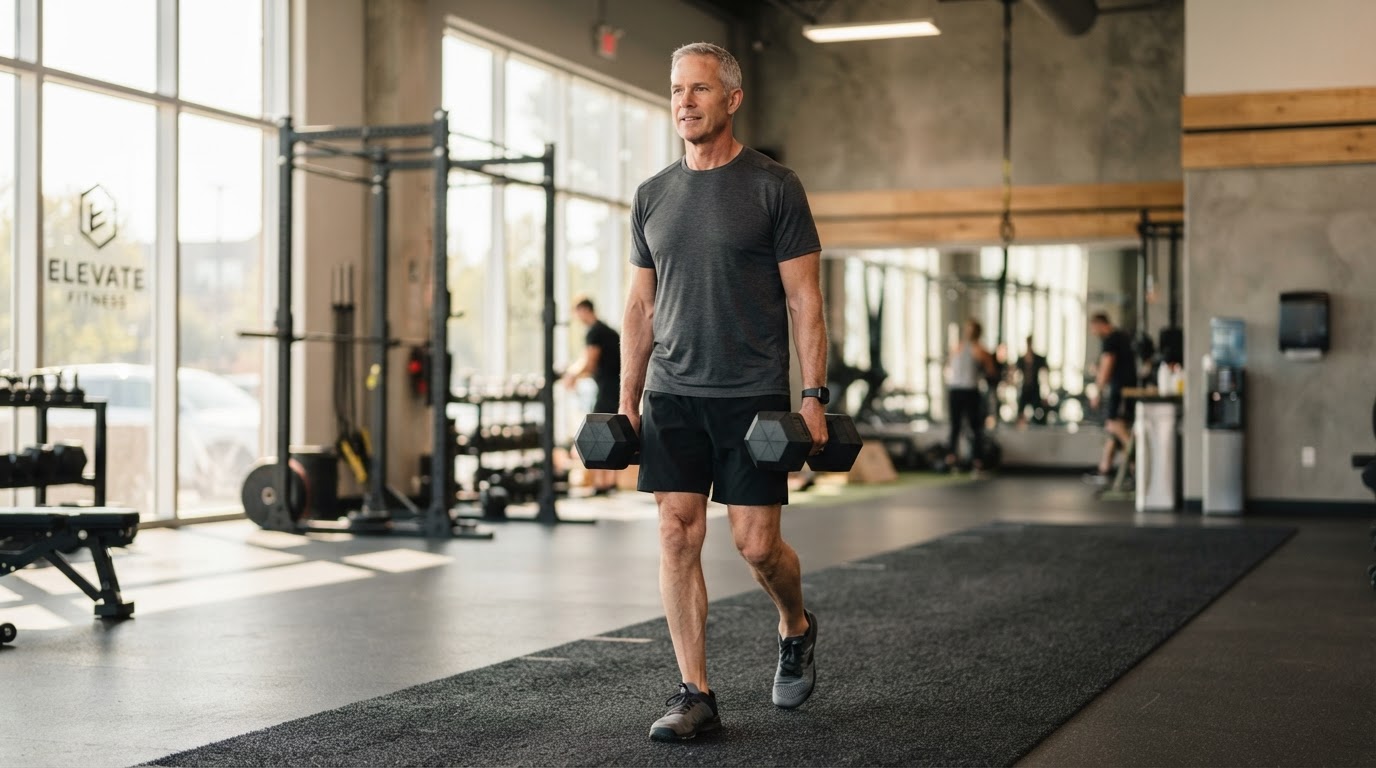
What 'Heavy' Actually Means
Heavy is relative to your own strength. A 30-pound dumbbell can be heavy for one exercise and very light for another.
Strength research often describes load as a percentage of one-repetition maximum, or 1RM. Moderate-to-heavy resistance generally begins around 70% of 1RM, while very heavy work moves higher.
How Heavy Should Men Over 50 Lift for Strength?
Older-adult consensus guidance commonly progresses healthy trainees toward roughly 70–80% of 1RM for strength development, with some position statements extending the range to about 85% depending on experience and program design.
That usually corresponds to loads you can lift for a moderate number of controlled repetitions rather than an all-out max every session.
How Heavy Should Men Over 50 Lift for Muscle?
Muscle can grow across a broader load range than strength. Moderate loads are practical because they allow enough mechanical tension without requiring maximal effort on every set.
If hypertrophy is your main goal, the load should still be challenging enough that the set ends reasonably close to fatigue.
How Heavy Should a Beginner Over 50 Start?
Beginners should start lighter. Expert guidance for older adults often begins around 30–50% of 1RM and progresses upward as technique, confidence and tolerance improve.
In practical terms, choose a weight you could probably lift several more times after the set ends. The first goal is to own the movement before chasing load.
If You Are Returning After Years Away
Do not start with the weights you used years ago. Strength can return quickly, but tendons, joints and overall work capacity may lag behind.
Our restarting strength training guide gives a more conservative return plan.
Use Rep Ranges to Choose the Weight
A simple method is to choose the weight by the rep target. If the plan calls for 8–12 reps, use a load that becomes challenging near the end of that range without forcing sloppy reps.
If you can easily do 15 or 20 reps when the target is 8–12, the load is probably too light for that specific goal.
RIR and RPE: Useful, but Not Perfect
Repetitions in reserve (RIR) estimates how many good reps you think you have left. Rating of perceived exertion (RPE) describes how hard the set feels.
Recent research in older adults shows RIR can be useful, but people may underestimate how many reps they actually have left. Use it as one tool alongside technique, rep speed and performance trends.
Do You Need to Test Your 1RM?
No. Experienced lifters may use 1RM testing to calibrate percentages, but most men do not need a true maximal test.
Rep ranges, controlled effort and gradual progression are enough for most recreational programs.
When to Increase the Weight
Increase the load when you can complete all planned sets at the top of the rep range with good technique and the effort is no longer very challenging.
Use small jumps whenever possible, especially for upper-body exercises.
Upper Body vs Lower Body Loading
Lower-body exercises usually tolerate larger absolute load increases than upper-body exercises. A 10-pound jump may be reasonable on a leg press but excessive on a lateral raise.
Choosing Dumbbell Weights
Use smaller jumps when possible. Adjustable dumbbells with fine increments make progression easier for presses, curls and shoulder work.
See our adjustable dumbbell buying guide.
Choosing Machine Weights
Machine numbers are not standardized. A 100-pound stack on one machine can feel very different from another. Use rep quality and effort instead of comparing machine numbers.
Choosing Resistance Band Tension
Band resistance rises as the band stretches. Choose a band that lets you complete the movement through a comfortable range while becoming challenging near the end.
If Your Joints Need a Friendlier Load
Reduce load, change range of motion or choose a different exercise if joint discomfort rises as the weight increases. A slightly lighter load with better movement quality can be more productive than forcing a painful heavier variation.
If You Have a Physical Job
Your workday contributes to fatigue. Use slightly more conservative loading during hard work weeks and avoid treating every gym session as a performance test.
If You Are Dieting for Fat Loss
Keep enough load in the program to preserve strength, but do not chase personal records while calories and recovery are lower.
If You Only Have 30 Minutes
Use fewer exercises and keep the main lifts challenging rather than filling the session with many light movements. Quality load progression matters more than exercise count.
Signs the Weight Is Too Light
- you finish the target reps with many easy reps left
- rep speed barely changes at the end of the set
- you have not progressed load or reps for weeks because nothing feels challenging
- the exercise feels more like warm-up than training
Signs the Weight Is Too Heavy
- technique breaks down early
- range of motion becomes much shorter
- you cannot reach the lower end of the planned rep range
- you repeatedly need momentum or assistance
- joint pain rises as load rises
Common Loading Mistakes After 50
- lifting too light forever because of age
- jumping straight to heavy loads after a long break
- testing max strength too often
- adding weight before technique is stable
- using the same load for every exercise
- treating soreness as proof that the weight was correct
When to Get Professional Guidance
Get individualized guidance if you have cardiovascular disease, uncontrolled blood pressure, recent surgery, major balance limitations or persistent pain that changes your movement.
Join the TrueMontis Newsletter
Get practical guidance on strength, recovery, mobility, supplements, nutrition, and staying capable after 50.