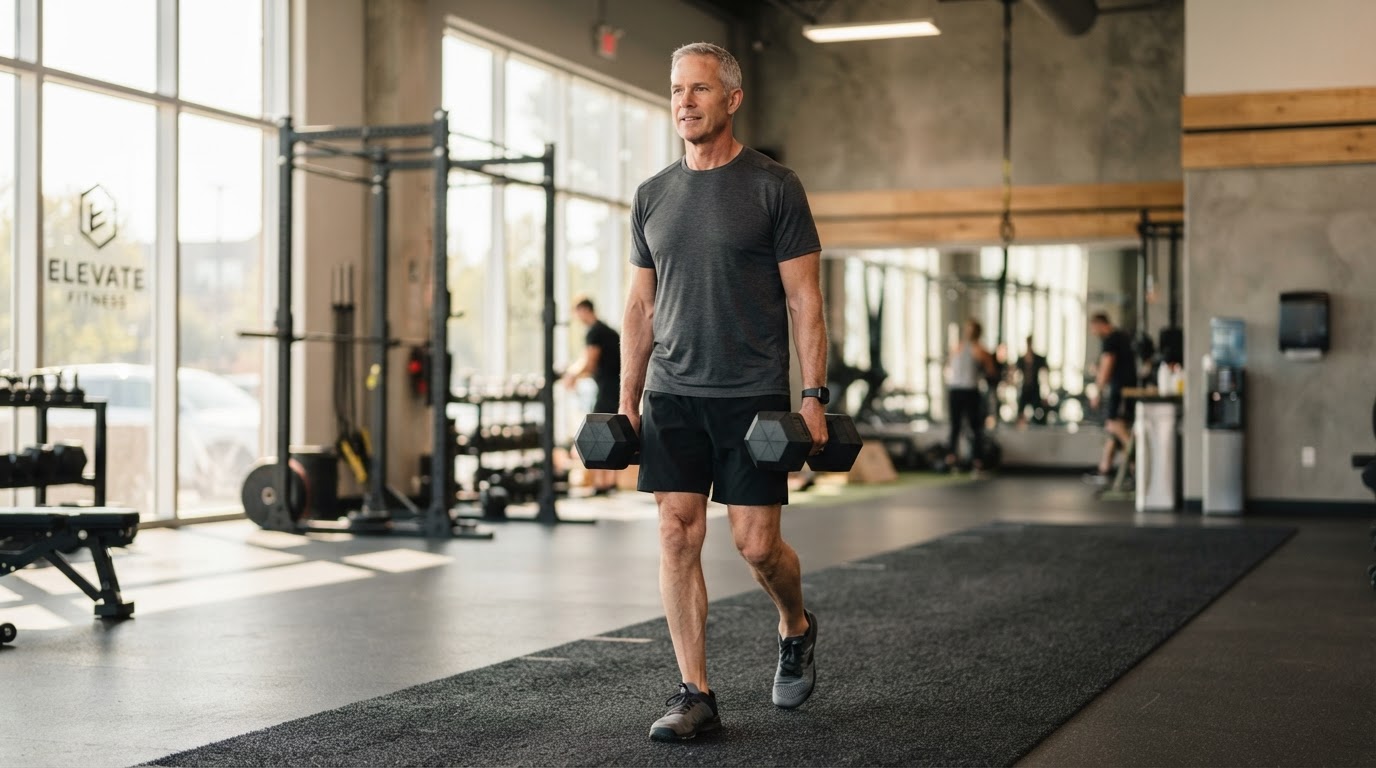
Why Restarting After 50 Is Different From Starting From Scratch
If you trained seriously in the past, you are not starting from zero. You likely still understand basic movements, gym etiquette, and how a barbell or dumbbell feels in your hands.
But what you may have lost over the years includes:
- conditioning and work capacity
- strength and muscle mass
- mobility and range of motion
- recovery tolerance — your ability to absorb training and bounce back
Previous experience can absolutely help. The movements may come back to you faster than they would for a complete beginner. But muscle memory should not become an excuse to progress too aggressively.
The key distinction is simple: your experience may return faster than your current training tolerance.
Your brain remembers how to squat, row, and press. Your muscles, tendons, and joints still need time to rebuild the capacity to do those things repeatedly and with load.
The Biggest Mistake: Trying to Train Like You Used To
A common mistake when returning to strength training after 50 is doing too much, too soon — then becoming too sore or fatigued to train consistently the following week.
Common mistakes include:
- using your old working weights on the very first session
- doing too many sets per exercise
- training to failure on every set
- adding too many exercises into a single workout
- training hard every day with no rest
- judging the new program against your performance from decades ago
The result is predictable: severe soreness, disrupted sleep, a sense of being overwhelmed, and eventually quitting — sometimes for another decade.
Excessive soreness does not prove that a workout was effective. It interferes with the one thing that actually drives progress: consistency.
If you are too sore to train again for five days, you have not built a training habit. You have built a reason to stop.
How Often Should You Strength Train After 50?
For many returning exercisers, two to three strength sessions per week provides a practical starting structure.
That frequency allows enough stimulus to drive adaptation while leaving enough recovery between sessions for a body that is rebuilding tolerance.
Frequency depends on several factors:
- your training experience
- your available schedule
- how well you recover between sessions
- total training volume per session
- other physical activity you do during the week
Two well-structured full-body sessions per week is a perfectly reasonable starting point. Three sessions can work well if recovery allows.
For a deeper breakdown of frequency, recovery, and weekly scheduling, see how often men over 50 should strength train.
No single schedule is medically mandatory. The best frequency is the one you can sustain without burning out or dreading your workouts.
Start With Basic Movement Patterns
Rather than chasing a long list of isolated exercises, build your routine around fundamental movement patterns. These cover the major muscle groups and movement directions your body needs. For more, browse our Strength & Training guides.
The core movement categories include:
- Squat / sit-to-stand pattern
- Hip hinge
- Horizontal push
- Horizontal pull
- Vertical push (when appropriate)
- Vertical pull (when appropriate)
- Loaded carry
- Core stability
Each pattern can be adjusted based on your available equipment, comfort, mobility, and training experience. A goblet squat, a leg press, and a bodyweight sit-to-stand all train the squat pattern — choose the variation that fits your situation.
You do not need to include every pattern in every workout. A simple full-body session might cover four to six of these patterns, rotating or combining them across the week.
A Simple Exercise Selection Example
Below is one way to organize a basic full-body session using common gym equipment. This is an example, not an individualized prescription — adjust it based on your equipment, experience, and comfort.
- Goblet squat or leg press
- Romanian deadlift or supported hip hinge
- Dumbbell bench press or push-up variation
- Cable row or supported dumbbell row
- Dumbbell overhead press (when comfortable)
- Lat pulldown
- Farmer carry
- A simple core exercise (e.g., plank or dead bug)
You do not need to do all of these in one session. A practical full-body workout might select one exercise from four to six of these categories.
The specific exercises matter less than the patterns they cover. Choose variations you can perform with control and reasonable technique.
Training at home instead? Our home strength training guide for men over 50 shows how to apply the same movement-pattern approach with simpler equipment.
How Hard Should Your First Workouts Feel?
One of the most useful concepts when returning to training is the idea of repetitions in reserve — how many more good repetitions you feel you could have completed before your technique broke down.
A practical starting approach:
Finish most early sets feeling like approximately 2–4 additional good repetitions may have been possible.
In other words, stop before you are grinding out a slow, shaky final rep. Leave something in the tank.
Avoid routine training to absolute failure during the initial return phase. The first objective is rebuilding tolerance and technique — not proving how hard you can push.
As your body adapts and you build confidence, you can gradually train closer to your limits on selected sets. But in the first few weeks, slightly easier is almost always better than slightly too hard.
Once you have rebuilt a baseline, read how close to failure men over 50 should train for the next layer of intensity guidance.
How Many Sets and Repetitions Should You Start With?
Keep it conservative at the beginning.
A practical starting framework:
- 1–2 working sets per exercise initially
- Approximately 6–12 controlled repetitions for many movements when appropriate
That is intentionally less than what many experienced lifters are used to doing. The reason is simple: your tendons, joints, and recovery capacity need time to catch up to your enthusiasm.
Exercise selection, load, experience, and individual situation all affect which repetition ranges make sense. Lower-rep compound movements and higher-rep accessory work can both have a place.
No single rep range is medically required. What matters is that the load is challenging enough to drive adaptation while controlled enough to maintain good technique.
If you want to go deeper on programming, see our guide to sets and reps for men over 50.
Progression: How to Get Stronger Without Rushing
The principle behind getting stronger is progressive overload — gradually increasing the demand on your muscles over time so they continue to adapt.
Progression does not only mean adding weight. You can progress by:
- adding a repetition
- improving your technique
- improving your range of motion
- increasing resistance gradually
- adding a set when appropriate
A simple example of gradual progression:
- Week 1: 8 repetitions
- Week 2: 9 repetitions
- Week 3: 10 repetitions
Then modestly increase the resistance and begin again at a slightly lower repetition count.
Progression does not require adding weight every workout. Small, steady improvements compound over months into real strength gains.
Patience here is not a weakness. It is the thing that keeps you training long enough to actually get strong.
When you are ready to progress more systematically, use the progressive overload after 50 guide rather than simply adding weight every session.
Recovery Matters More Than It Used To
Recovery has always mattered. But as you rebuild training after a long break, it becomes an increasingly important part of sustainable progress. For a deeper look, see our guide on why recovery changes after 50.
Factors that influence how well you recover include:
- sleep quality and duration
- protein and calorie intake
- hydration
- rest days between sessions
- stress levels
- workload outside the gym (physical job, sports, family demands)
This is not about recovery suddenly collapsing at age 50. It is about recognizing that recovery is a key variable — not an afterthought. Some men also consider well-researched supplements like creatine monohydrate to support their training, but supplements only matter once the basics are in place.
If you are sleeping poorly, under-eating, and training hard every day, progress will stall regardless of how good your program looks on paper.
Frame it this way: recovery becomes an increasingly important part of sustainable training, not a sign that your body has given up.
Soreness Is Not the Goal
There is a common belief that being sore for days after a workout means it was effective. For someone restarting training, this mindset can be destructive.
It helps to distinguish between:
- normal post-training soreness — mild to moderate muscle soreness that fades within a day or two
- excessive soreness — severe soreness that makes basic movement difficult for three to five days
Some soreness is normal when you start training again or change your routine. But a productive workout does not have to make walking downstairs difficult for three days.
If you are consistently debilitated after sessions, you are likely doing too much volume, too much intensity, or too many new exercises at once.
The goal is enough stimulus to drive adaptation — not so much that you cannot train again on schedule.
When to Slow Down or Get Professional Guidance
Strength training is generally safe for healthy adults when approached sensibly. But certain situations call for caution or professional evaluation.
Consider consulting a qualified healthcare professional before or during training if you experience:
- persistent or sharp pain (especially joint pain that lingers)
- chest pain or pressure
- unexplained dizziness
- unusual shortness of breath
- recent surgery
- significant cardiovascular disease
- uncontrolled medical conditions
- major orthopedic limitations or injuries
This guide does not diagnose conditions or replace medical advice. If something feels wrong, stop and get it evaluated.
A qualified healthcare professional or physical therapist can help you understand what is safe for your specific situation before you commit to a training program.
A Simple 4-Week Strength Restart Framework
Below is an example framework for the first four weeks back. This is an example, not individualized medical or training advice. Adjust it based on your experience, recovery, and schedule.
Week 1 — Relearn Movements
Goal: reacquaint your body with the basic patterns.
- 2 sessions
- light to moderate resistance
- 1–2 working sets per exercise
- stop well before failure
Week 2 — Build Consistency
Goal: repeat the patterns and establish the habit.
- repeat the basic movement patterns
- slightly improve repetitions or technique
- maintain manageable soreness
Week 3 — Begin Gradual Progression
Goal: start increasing the challenge modestly.
- modest increase in repetitions or resistance
- maintain good technique
- avoid dramatic jumps in workload
Week 4 — Establish Baseline
Goal: evaluate where you are and plan the next block.
Take stock of:
- exercises that feel productive
- weights being used
- repetitions completed
- recovery between sessions
- schedule adherence
Then build the next training block from that baseline — adding volume or resistance gradually rather than all at once.
TrueMontis Tip
The best restart program is not the hardest plan you can survive for two weeks. It is the plan you can continue long enough to become stronger.
Join the TrueMontis Newsletter
Get practical guidance on strength, recovery, mobility, supplements, nutrition, and staying capable after 50.