Why Resistance Bands Make Sense After 50
Resistance bands are low-cost, portable and space-efficient. NIA includes resistance bands among practical muscle-strengthening tools for older adults, and ACE notes that elastic resistance can improve strength and daily function across a wide range of ability levels. For the broader home-gym buying framework, see Best Home Strength Training Equipment for Men Over 50.
The main advantage is accessibility: you can train in a bedroom, living room, hotel or office without a rack of weights.
The Main Types of Resistance Bands
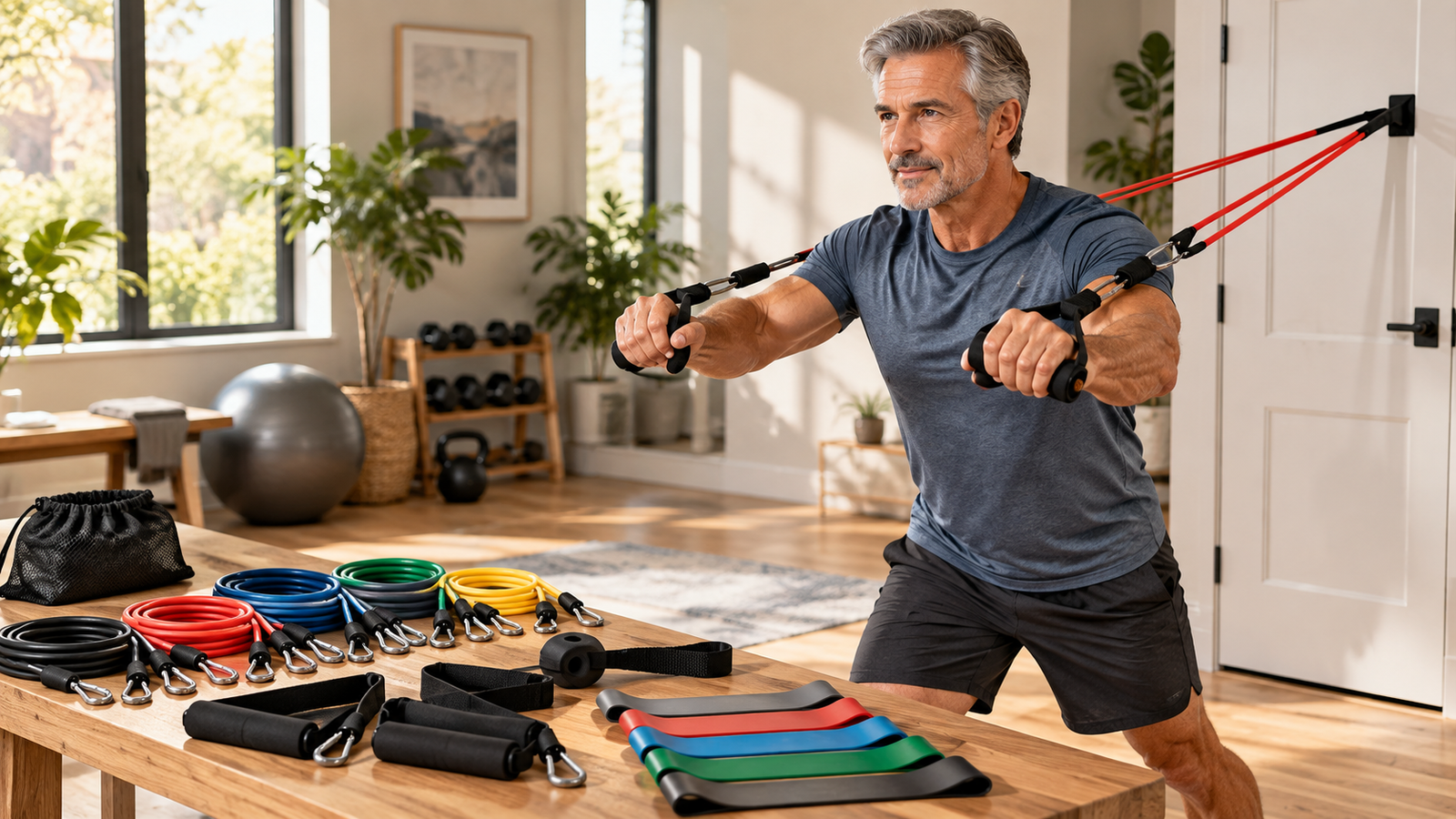
Current buying guides repeatedly divide the category into handled tube bands, long loop or power bands, mini loops, therapy bands and fabric loops. The styles overlap, but each has a different practical sweet spot.
Choose a Resistance Band by Your Situation
If You Are a Beginner
Handled tube bands are often the easiest because the grip and anchor points are intuitive.
If You Are Returning to Strength Training
Choose a set with several resistance levels so you can start light and progress without replacing the kit.
If You Travel Frequently
Long loops or compact tube sets provide the most exercise variety for very little luggage space.
If You Want Heavy Resistance
Long loop or power bands usually provide the highest useful resistance range.
If You Mostly Want Hip and Glute Work
Mini bands or fabric loops are usually more comfortable and easier to position.
1. Tube Bands With Handles
Tube bands with handles are beginner-friendly and work well for rows, presses, curls, lateral raises and many anchored exercises.
Look for secure clips, comfortable handles and a quality door anchor. Stackable tubes add more progression options than single fixed-resistance tubes.
2. Long Loop / Power Bands
Long continuous loops are highly versatile. They can be used for rows, presses, hinges, squats, assisted pull-ups and mobility work.
They usually require more setup knowledge than handled tubes, but they are one of the most adaptable band styles for a home gym.
3. Mini Loop Bands
Mini bands are best for hip abduction, glute activation, lateral walks and warm-ups. They are inexpensive and compact but should not be mistaken for a complete full-body strength system.
4. Flat Therapy Bands
Flat bands are useful for lighter resistance, mobility and rehabilitation-style exercises. They can also be tied into loops, but they are less convenient for heavy full-body strength work than tubes or long loops.
5. Fabric Bands
Fabric bands are popular for lower-body work because they often roll less and feel more comfortable against the skin. They tend to be less versatile for upper-body and anchored movements.
6. Resistance Range
Buy a set that covers both lighter and heavier exercises. Smaller upper-body movements need less resistance, while rows, presses and lower-body exercises usually need more.
Band colors are not standardized across brands, so do not assume the same color means the same resistance from one company to another.
7. Handles and Grip Comfort
If hand comfort or grip is a concern, handles can make band training much easier. Look for enough handle length, a non-slip surface and secure attachment points.
8. Door Anchors and Attachments
A door anchor expands exercise variety significantly. It makes rows, pulldowns, presses and triceps work easier to set up.
Use only a sturdy door and position the anchor according to the manufacturer's instructions.
9. Latex, Rubber and Fabric
Latex and rubber provide good elasticity and are common in tube and loop bands. Fabric can feel more comfortable for lower-body loops. Latex-free options are important for people with latex sensitivity.
10. Progression and Stackability
A good set makes progression simple. Stackable tubes, multiple loop thicknesses or clearly separated resistance levels let you increase challenge gradually.
Best Resistance Band Type for Beginners Over 50
A handled tube set with light, medium and heavier options is often easiest. The handles make exercise setup familiar, and a door anchor expands the exercise list.
Best Resistance Band Type for Returning Lifters
Choose a wider resistance range than you need today. Strength can return quickly once you train consistently, so a set with room to progress avoids an early replacement.
Best Resistance Bands for Travel
Long loops and compact handled tubes offer the best combination of portability and exercise variety. A carrying bag is useful but not essential.
Best Resistance Bands When Joint Comfort Matters
Bands allow you to choose a comfortable resistance and range of motion, but they are not automatically pain-free. Start light and avoid forcing painful joint positions.
Best Resistance Bands for Small Spaces
Bands are one of the best small-space options because the equipment footprint is tiny. The bigger issue is having enough clear space around the anchor point to move safely.
Best Resistance Band Type for Full-Body Training
Handled tubes and long loop bands are the strongest choices for full-body training because they can cover pushing, pulling, squatting, hinging, arm and shoulder work.
Resistance Bands vs Adjustable Dumbbells
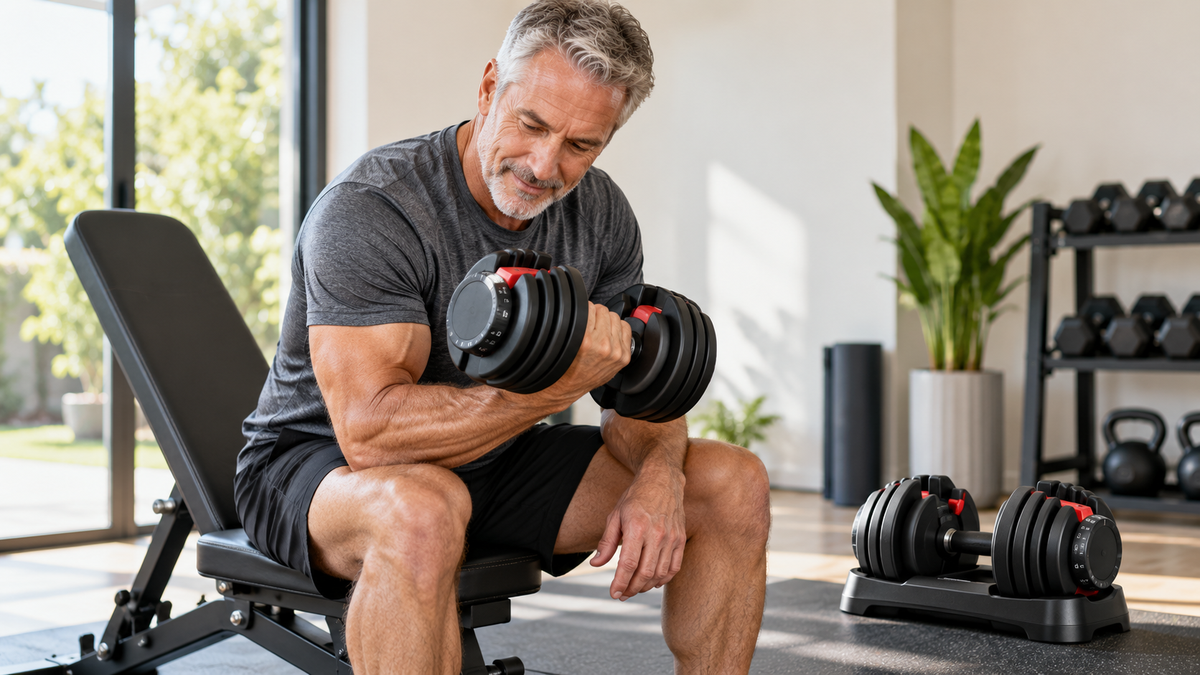
Bands are cheaper, more portable and easier to store. Dumbbells provide more predictable loading and a familiar resistance curve. Many home trainees eventually benefit from both.
See our adjustable dumbbell buying guide for the other side of the decision.
Where Future Product Comparisons Will Fit
Specific product comparisons can later be added using the same criteria: band type, resistance range, handles, anchor quality, material, portability, durability, accessories and delivered price.
Resistance Band Safety
Inspect bands before every session. Replace any band with cracks, thinning, tears, damaged clips or worn anchor points. Avoid anchoring bands around sharp edges.
Do not stretch a band beyond the manufacturer's recommended limit. Elastic failure can send the band or attachment back toward the body quickly.
Resistance Band Buying Red Flags
- unclear resistance range
- cheap clips or carabiners on handled sets
- door anchors with weak stitching
- no material disclosure for latex-sensitive users
- no replacement or warranty information
- marketing that treats mini bands as a complete heavy-strength system
Common Resistance Band Buying Mistakes
- buying only one resistance level
- choosing by color instead of actual resistance
- buying mini bands when you need full-body training
- ignoring anchor quality
- buying very heavy bands before learning setup and control
- keeping damaged bands in service too long
Join the TrueMontis Newsletter
Get practical guidance on strength, recovery, mobility, supplements, nutrition, and staying capable after 50.