What Recovery Equipment Can — and Cannot — Do
Recovery equipment can improve comfort, perceived soreness, range of motion or the convenience of self-treatment. Those are useful outcomes, but they are not the same as dramatically accelerating tissue repair.
Current 2026 buying guides increasingly separate low-cost mechanical tools from premium technologies such as pneumatic compression and photobiomodulation because the evidence, price and use case are very different.
Choose Recovery Equipment by Your Situation
If You Lift Two or Three Days per Week
Start with simple tools. A foam roller, massage ball and normal mobility work may be enough.
If You Train Hard Five or More Days per Week
Convenience becomes more valuable. A massage gun or compression system may earn its place if you actually use it regularly.
If Your Job Is Physically Demanding
Total workload matters more than gear. Recovery equipment can improve comfort, but your training volume may need to be lower.
If Joint Comfort Is the Main Issue
Do not assume a muscle-recovery device will solve a joint problem. Targeted mobility, medical evaluation and joint-specific interventions may matter more.
If You Travel
Portability usually beats sophistication. Small manual tools or compact percussion devices are easier to use consistently away from home.
1. Foam Roller
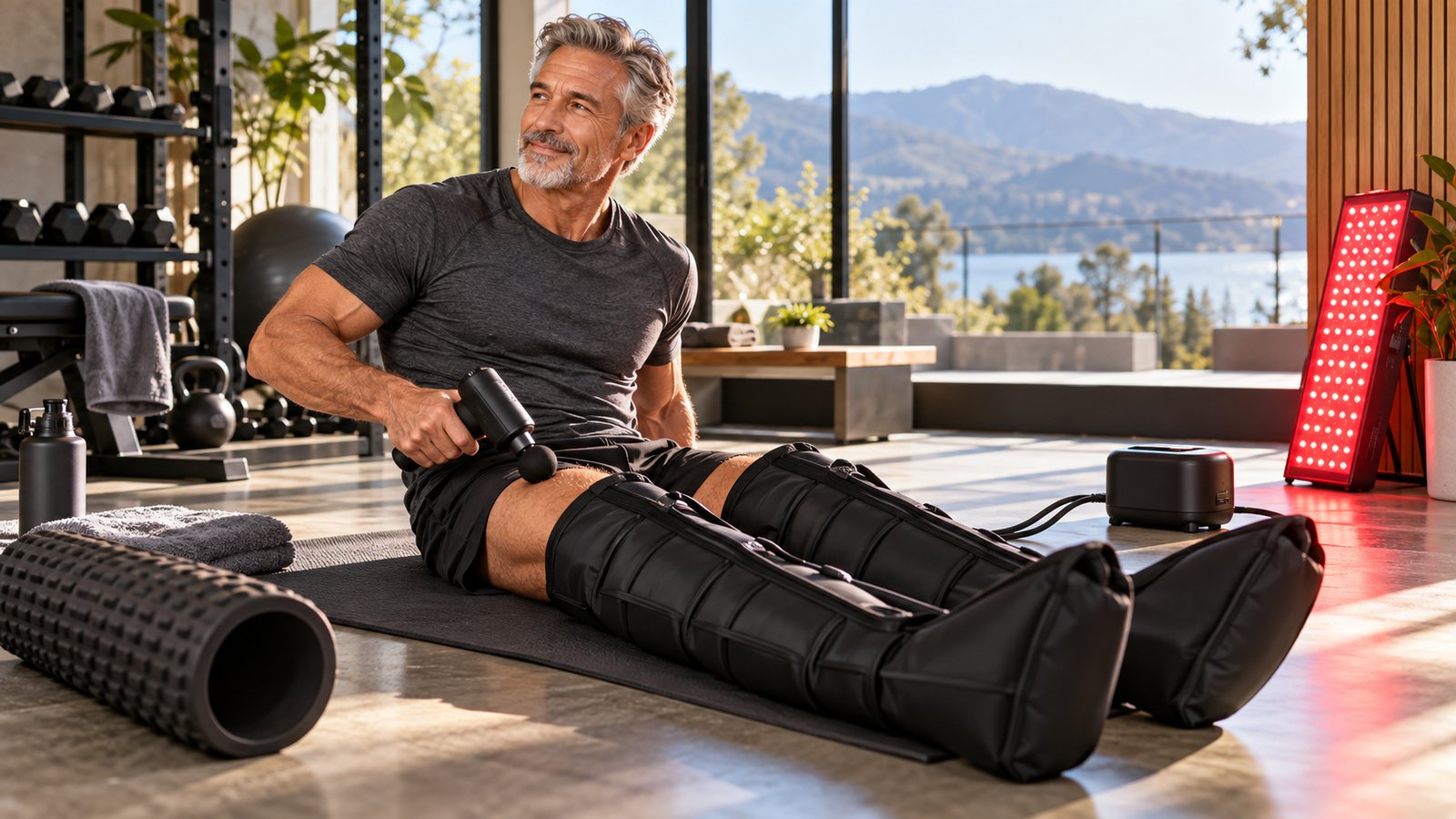
Foam rollers remain the highest-value entry point because they are inexpensive, durable and useful for large muscle groups.
Research suggests foam rolling can improve short-term range of motion and may modestly reduce perceived soreness after hard exercise.
2. Massage Ball
Massage balls target smaller areas such as the glutes, feet and upper back. They are cheap, portable and often easier to control than aggressive textured rollers.
3. Massage Gun
Massage guns add speed and convenience. A 2023 systematic review found potential benefits for flexibility and some recovery-related outcomes, but did not find broad improvements in strength, balance, acceleration, agility or explosive performance.
That makes a massage gun best viewed as a self-massage and mobility tool rather than a performance shortcut.
4. Compression Boots
Pneumatic compression boots use sequential air pressure around the legs. They are popular because the treatment is passive: you sit while the device cycles.
A 2024 systematic review and meta-analysis found trivial-to-small benefits for muscular function and trivial-to-moderate effects on soreness, while a 2025 review concluded that evidence is still too limited to show clear superiority over other recovery methods.
5. Red-Light / Photobiomodulation Devices
Photobiomodulation uses red and near-infrared light. Some meta-analyses of localized treatment report improvements in muscle endurance or recovery-related outcomes, but results depend heavily on wavelength, dose and treatment protocol.
A 2025 systematic review of whole-body photobiomodulation found only five studies and no benefit for fatigue biomarkers or exercise performance. That means a large panel and a targeted wearable should not automatically be treated as equivalent products.
6. Heat-Based Recovery Tools
Heating pads, heated wraps and infrared devices can improve comfort and relaxation. Heat is best treated as a comfort and mobility tool rather than a guaranteed accelerator of muscle repair.
7. Cold-Recovery Equipment
Cold packs and cold-water systems can temporarily reduce soreness and discomfort. More elaborate cold plunges add cost, maintenance and space requirements.
If muscle growth is a priority, avoid assuming that routine immediate post-lifting cold exposure is always beneficial. Recovery goals and training adaptation are not always the same thing.
8. EMS / Electrical Stimulation Devices
Electrical muscle stimulation devices are marketed for recovery, circulation and muscle activation. Evidence varies by device, protocol and outcome, so they should be evaluated as a specialized tool rather than a default purchase.
Best Recovery Setup on a Budget
Start with a foam roller and massage ball. If those tools are used consistently and you still want more convenience, add a midrange massage gun before moving into high-ticket equipment. For the lower-cost tool category and practical use cases, see Best Recovery Tools for Men Over 50.
Best Recovery Equipment for Men Who Lift Weights
Foam rollers and massage guns are the most practical because they target large and small muscle groups without requiring much setup.
If soreness is repeatedly excessive, see our muscle soreness guide before buying more equipment.
Best Recovery Equipment for Men With Physical Jobs
A massage gun or heat tool can be convenient after long workdays, but the real constraint may be total physical workload. Equipment should not be used to mask a recovery problem caused by excessive weekly stress.
Best Recovery Equipment for Walkers, Hikers and Cardio
Massage balls, foam rollers and compression systems are most relevant for feet, calves, quads and hips. Premium leg-compression equipment becomes more reasonable when lower-body training volume is consistently high.
Best Recovery Equipment for Travel
A massage ball, mini roller or compact percussion device is easier to carry than boots or a large light panel. Recovery equipment only helps if it actually travels with you.
Best Recovery Options When Joint Comfort Matters
Muscle massage and joint treatment are not the same thing. If the problem is persistent joint stiffness or pain, see our joint mobility guide and consider professional evaluation when symptoms persist.
What Specs Actually Matter
Massage Guns
Weight, noise, battery life, amplitude, speed range, attachments and handle ergonomics.
Compression Boots
Pressure settings, chamber overlap, fit, battery, portability and session controls.
Red-Light Devices
Wavelengths, irradiance, treatment area, distance, treatment time and whether published specs are complete.
Cold and Heat Equipment
Temperature range, safety controls, cleaning requirements, storage and operating cost.
Where Future Product Comparisons Will Fit
Specific product comparisons can later be inserted here using the same framework: evidence fit, specifications, ease of use, warranty, portability, replacement parts, total delivered cost and who the product is actually for.
Recovery Equipment Red Flags
- claims to eliminate inflammation or accelerate healing dramatically
- no published technical specifications
- large wellness claims based only on testimonials
- no warranty or replacement-part policy on expensive devices
- pressure, temperature or light settings with no usable instructions
- products marketed as substitutes for medical treatment
Common Recovery Equipment Buying Mistakes
- buying premium gear before fixing sleep and training volume
- assuming more expensive means stronger evidence
- buying a device that is too inconvenient to use regularly
- confusing temporary relief with tissue healing
- using aggressive settings because stronger feels more effective
- buying several tools that solve the same problem
When Recovery Equipment Is the Wrong Answer
Persistent pain, swelling, weakness, numbness, tingling, loss of function or unexplained symptoms should be evaluated instead of repeatedly treated with a recovery device.
Join the TrueMontis Newsletter
Get practical guidance on strength, recovery, mobility, supplements, nutrition, and staying capable after 50.