Why Resistance Bands Work Well for Men Over 50
Resistance bands create external resistance just like dumbbells or machines do, but the tension changes as the band stretches. That makes them versatile for home workouts and useful when you need several resistance levels without storing a large amount of equipment.
Research in older adults suggests elastic-band resistance training can improve strength and physical function. A 2024 systematic review included 28 studies and found improvements in several physical outcomes, while a 2025 meta-analysis reported benefits for lower-body strength and balance. The studies are heterogeneous, so bands should be viewed as a practical training tool rather than a special age-specific solution.
Who Resistance Band Training Works Best For
Bands are especially useful if you:
- train at home with limited space
- travel frequently
- are new to resistance training
- want an inexpensive way to add pulling movements to a bodyweight routine
- need lighter resistance for certain shoulder or rehabilitation-style movements
- want extra exercise options without buying a large home gym
Which Type of Resistance Band Should You Use?
Long loop bands are versatile for rows, squats, presses and assisted movements. Tube bands with handles can be convenient for pressing and rowing. Mini loops are useful for certain hip and lower-body exercises but are not a complete full-body solution by themselves.
A set with several resistance levels is more useful than one band because your legs and back usually need more resistance than your shoulders or smaller accessory movements. If you are choosing what to buy, use our resistance-band buying guide for men over 50.
1. Resistance Band Squat
Stand on the band and bring the upper portion to shoulder height or hold the handles near your shoulders. Squat to a depth you can control, then stand against the increasing band tension.
Use a chair target if balance or depth is uncertain. The band should add resistance, not pull you out of position.
2. Resistance Band Row
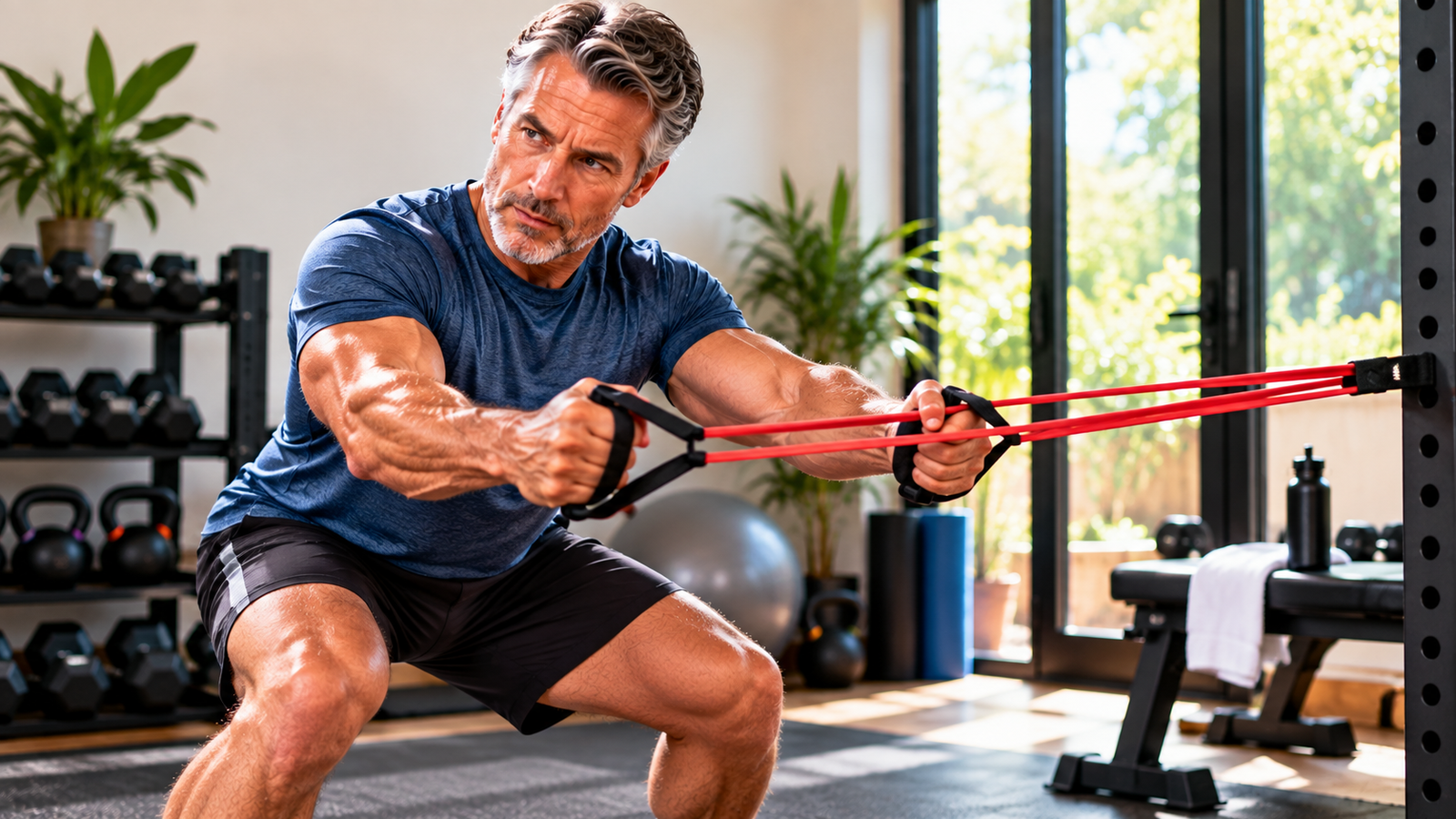
Anchor a band securely in front of you or loop it around the feet for a seated variation. Pull the handles or band toward your lower ribs while keeping the torso controlled.
Rows are especially valuable because they solve one of the biggest weaknesses of bodyweight-only home programs: a lack of practical upper-back pulling exercises.
3. Resistance Band Chest Press
With a securely anchored band behind you, press forward as you would in a cable chest press. A staggered stance can improve stability.
Check the anchor carefully before every set. If you do not have a safe anchor, use push-ups or dumbbell pressing instead of improvising.
4. Resistance Band Romanian Deadlift
Stand on the band, hold the ends, soften the knees and push the hips backward. Keep the band close to the legs and stand by extending the hips.
This trains the hinge pattern, but stronger men may outgrow lighter bands quickly. Use a heavier band or dumbbells when the movement stops being challenging.
5. Resistance Band Overhead Press
Stand on the band and press overhead while keeping the ribs and trunk controlled. Use a lighter band than you would for rows or lower-body work.
Overhead pressing is optional. If it causes persistent shoulder pain or you cannot raise the arms comfortably, choose another pressing angle.
6. Supported Split Squat With a Band
A split squat lets one leg work harder without needing extremely heavy resistance. Hold a stable support with one hand if balance is limiting and use the band to add resistance through the movement.
7. Pallof Press
Anchor the band to your side, hold it at the chest, then press the hands straight forward while resisting the band's attempt to rotate your torso.
This is a practical trunk-control exercise and is easier to scale than many advanced floor core exercises.
8. Band Pull-Apart or Face Pull
A pull-apart uses a light band held in front of the chest. Pull the hands apart under control without turning the movement into a shrug.
A face pull requires a secure anchor and can be another useful upper-back accessory. These movements should complement rows, not replace them.
Beginner Resistance Band Workout for Men Over 50
Start with two rounds of:
- Band squat — 8–12 reps
- Band row — 8–12 reps
- Band chest press or incline push-up — 8–12 reps
- Band Romanian deadlift — 8–12 reps
- Pallof press — 8–10 reps per side
Use a resistance level that allows controlled repetitions and leaves a few good reps in reserve. Beginners do not need to train every set to failure.
20-Minute Full-Body Resistance Band Workout
For busy men, use four movements: squat, row, chest press and hip hinge. Perform two or three controlled rounds with enough rest to maintain technique.
A short session can be effective when the resistance is meaningful. Do not compensate for an overly light band by simply moving faster.
Resistance Band Training While Traveling
Bands are one of the easiest strength tools to pack. A long loop or tube-band set can give you squats, hinges, rows, presses and trunk work in a hotel room.
Avoid anchoring bands to hotel furniture or fixtures unless you are certain they are designed to tolerate the load.
Are Resistance Bands Joint-Friendly After 50?
Bands can feel comfortable because you can adjust the line of pull, resistance level and range of motion. That does not make every band exercise appropriate for every joint.
If an exercise produces persistent pain, change the range, resistance or movement rather than assuming the band itself makes the exercise safe.
How to Progress With Resistance Bands
You can progress band exercises by:
- using a stronger band
- starting with more stretch in the band
- adding repetitions within a sensible range
- adding a set
- increasing range of motion
- moving to a harder single-leg or unilateral variation
Keep progression measurable. Band colors are not standardized across brands, so record the actual band or setup you use instead of assuming one color always equals a specific load.
Resistance Bands vs Dumbbells After 50
Bands win on portability, storage and cost. Dumbbells usually make load tracking and long-term progression easier because the weight is fixed and measurable.
You do not need to choose one system forever. Many home programs use both. See our dumbbell exercise guide if you are deciding when to add free weights.
How Often Should Men Over 50 Train With Resistance Bands?
Two or three full-body resistance sessions per week is a practical range for many men. The band is simply the resistance tool; recovery principles are the same as with dumbbells, machines or bodyweight training.
Our strength-training frequency guide compares two-, three- and four-day schedules.
Common Resistance Band Training Mistakes After 50
- using the same easy band for months
- doing only shoulder and rehab-style movements instead of full-body training
- using momentum instead of controlled tension
- anchoring bands to unstable furniture
- ignoring wear, cracks or damage in the band
- assuming more stretch is always better
- training through persistent joint pain
Resistance Band and Anchor Safety
Inspect bands before use and replace them when you see cracks, tears or obvious deterioration. Secure anchors to something designed to tolerate the direction of pull.
Keep the band out of your face and eyes when possible, and do not stretch a damaged band to its limit. A snapped band can recoil quickly.
When to Get Professional Guidance
Get individualized guidance if you have a recent surgery or injury, significant balance limitations, persistent pain, or a medical condition that affects exercise tolerance.
If you are completely new to training, our strength training after 50 pillar guide is the best place to understand the overall framework.
Join the TrueMontis Newsletter
Get practical guidance on strength, recovery, mobility, supplements, nutrition, and staying capable after 50.