Can Bodyweight Training Build Strength After 50?
Yes. Resistance training does not require a barbell or machine. Bodyweight exercises can challenge muscles enough to improve strength, particularly when you are a beginner, returning after a long break, or using more difficult variations over time.
The limitation is that your bodyweight is a fixed load. You can manipulate leverage, range of motion, tempo and single-leg or single-arm variations, but eventually some movements become easier to progress with external resistance.
Who Bodyweight Training Works Well For
Bodyweight training is especially practical for:
- men over 50 who have never strength trained
- men returning after years away from exercise
- busy men who want a short home routine
- men who travel and cannot rely on gym access
- men who want to build confidence before using weights
- people with limited space or no home-gym budget
If you are coming back after a long break, also read restarting strength training after 50.
1. Chair Squat or Bodyweight Squat
Squatting trains the thighs, hips and trunk and closely resembles standing up from a chair. If a free squat feels uncertain, start with a sturdy chair behind you and sit down under control before standing again.
To progress, reduce how much you use your hands, use a slightly lower seat, pause near the bottom, or move to free-standing squats. Once these become easy, a goblet squat with a dumbbell is a logical next step.
2. Incline Push-Up
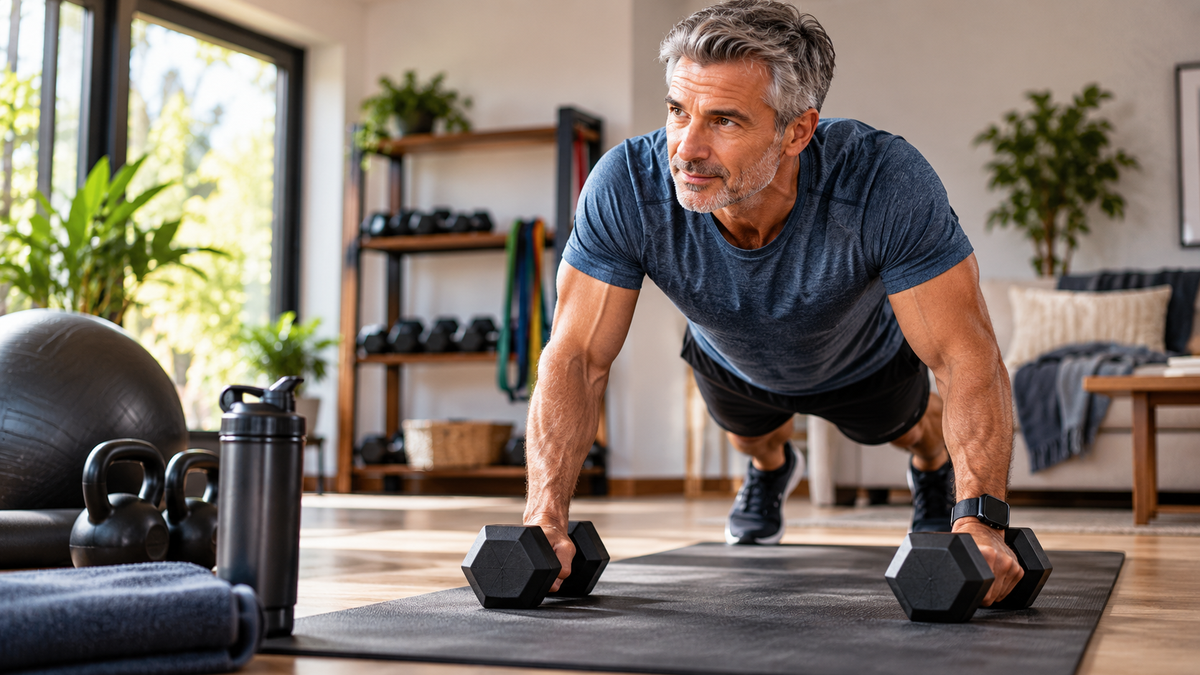
An incline push-up trains the chest, shoulders, triceps and trunk while letting you choose the difficulty. A wall is easiest; a kitchen counter, sturdy table or bench becomes harder as the hands move closer to the floor.
This progression is useful for men who cannot yet perform controlled floor push-ups. Lower the incline gradually instead of forcing poor repetitions from the floor.
3. Step-Up
Step-ups train the legs one side at a time and directly resemble climbing stairs. Use a stable low step and drive through the working leg rather than bouncing off the trailing foot.
Hold a railing or stable support if balance is the limiting factor. Progress by increasing control, repetitions or step height within a comfortable range.
4. Supported Split Squat
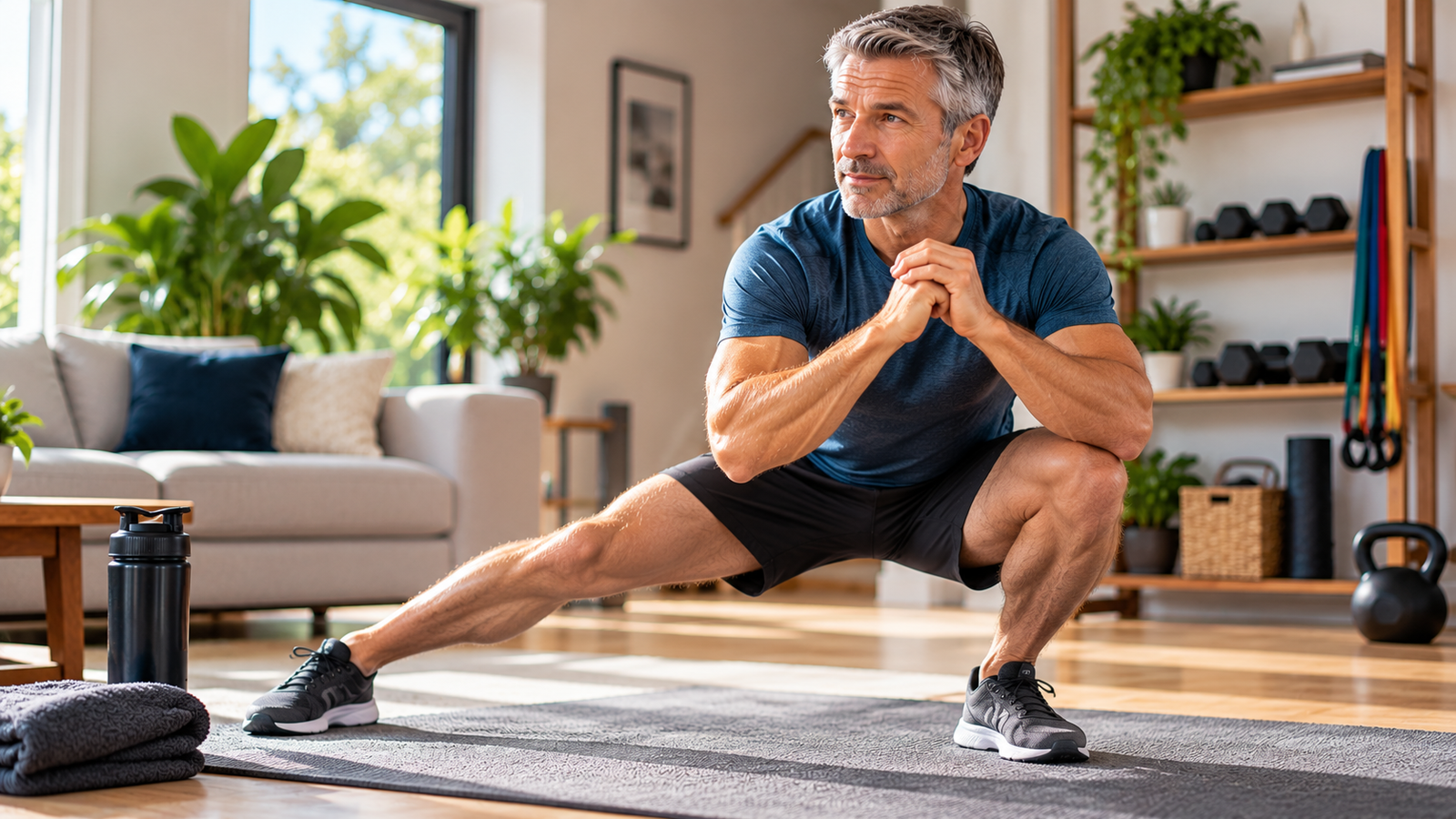
A supported split squat lets each leg work harder than it would in a normal bodyweight squat. Stand in a staggered stance and hold a stable surface lightly for balance.
Lower only as far as you can control. As strength improves, use less hand support, increase range of motion or eventually add dumbbells.
5. Glute Bridge
The glute bridge trains hip extension without requiring standing balance. Lie on your back with knees bent, brace your trunk, and lift the hips by squeezing the glutes.
Progress with longer pauses, more controlled repetitions or single-leg variations only after the basic version is comfortable. If getting to the floor is difficult, choose a standing hip-hinge variation instead.
6. Calf Raise
Calf raises train the lower leg and are easy to perform near a wall or chair for balance. Rise onto the balls of the feet, pause briefly, and lower under control.
Progress from two legs to more weight on one leg, then to single-leg work if balance and ankle comfort allow.
7. Dead Bug or Bird Dog
These exercises train trunk control rather than simply asking you to perform many crunches. A dead bug works from the back; a bird dog works from hands and knees.
Move slowly enough that your trunk position remains controlled. If getting to the floor is uncomfortable, standing anti-rotation work with a resistance band is another option.
8. Elevated Plank or Front Plank
A plank challenges the trunk and shoulders isometrically. Begin with hands on a wall, counter or bench if a floor plank is too demanding.
Quality matters more than holding forever. End the set when you can no longer maintain the intended body position.
The Pulling Problem With No-Equipment Bodyweight Workouts
Most no-equipment routines have one major weakness: they include plenty of pushing and leg work but very little pulling for the upper back.
Pull-ups and inverted rows are bodyweight exercises, but they require a safe bar, rings, suspension trainer or another truly stable anchor. Do not improvise with furniture that is not designed to support your bodyweight.
If you have no safe pulling setup, a resistance band or dumbbell is a small equipment upgrade that can make the program more balanced.
Beginner Bodyweight Workout for Men Over 50
Start with two rounds of:
- Chair squat — 8–12 controlled reps
- Incline push-up — 6–12 reps
- Step-up — 6–10 reps per side
- Glute bridge — 10–15 reps
- Bird dog — 6–10 controlled reps per side
Rest enough to keep the movements controlled. The goal is to finish feeling that you trained, not that you survived a circuit.
15-Minute No-Equipment Workout for Busy Men Over 50
If time is limited, choose four movements that cover most of the body:
- Chair or bodyweight squat
- Incline push-up
- Step-up or supported split squat
- Bird dog or plank
Perform two controlled rounds. A short workout is useful when it helps you stay consistent, but it does not need to become a frantic high-intensity circuit.
Bodyweight Exercises If You Are Overweight or Deconditioned
Bodyweight movements can actually be harder when you carry more body mass, so “no equipment” does not automatically mean easy. Start with higher supports and smaller ranges of motion.
- Use a wall or high counter for push-ups.
- Use a higher chair for squats.
- Choose a low step and hold a support.
- Keep early sessions short enough that recovery is manageable.
Progress is measured against your own starting point, not against someone demonstrating an advanced variation online.
Joint-Friendly Bodyweight Modifications After 50
If Your Knees Are Sensitive
Use a chair squat, reduce squat depth, lower the step height, or use hand support during a split squat. Persistent or worsening pain should be evaluated.
If Your Shoulders Are Sensitive
Raise the push-up surface and keep the movement within a comfortable range. You do not need floor push-ups or pike push-ups to have an effective program.
If Your Back Is Sensitive
Use controlled hip and trunk exercises and avoid turning fast circuits into sloppy repetitions. Pain that radiates or is associated with weakness, numbness or other neurological symptoms deserves professional evaluation.
Bodyweight Training While Traveling
Travel is one of the strongest use cases for bodyweight training. A hotel room can support squats, incline push-ups, split squats, calf raises, planks and bird dogs without carrying equipment.
Do not worry about perfectly reproducing your home program for a few days. The goal is to maintain the habit and return to normal progressive training when your regular equipment is available again.
How to Progress Bodyweight Exercises Without Adding Weights
You can increase difficulty by changing leverage and execution:
- increase the range of motion
- use a lower incline for push-ups
- move from two-leg to supported single-leg variations
- add controlled pauses
- slow the lowering phase
- add repetitions within a sensible range
- add another set
Once these changes stop being practical, adding external resistance is usually more efficient than turning every set into dozens of repetitions.
When Bodyweight Is No Longer Enough
Bodyweight training is not a religion. If your squats, bridges or push-ups have become easy despite reasonable progressions, external resistance gives you a simpler way to keep improving.
Dumbbells are an especially useful next step. Our dumbbell exercise guide for men over 50 shows how to transition without changing the entire program.
How Often Should Men Over 50 Do Bodyweight Strength Training?
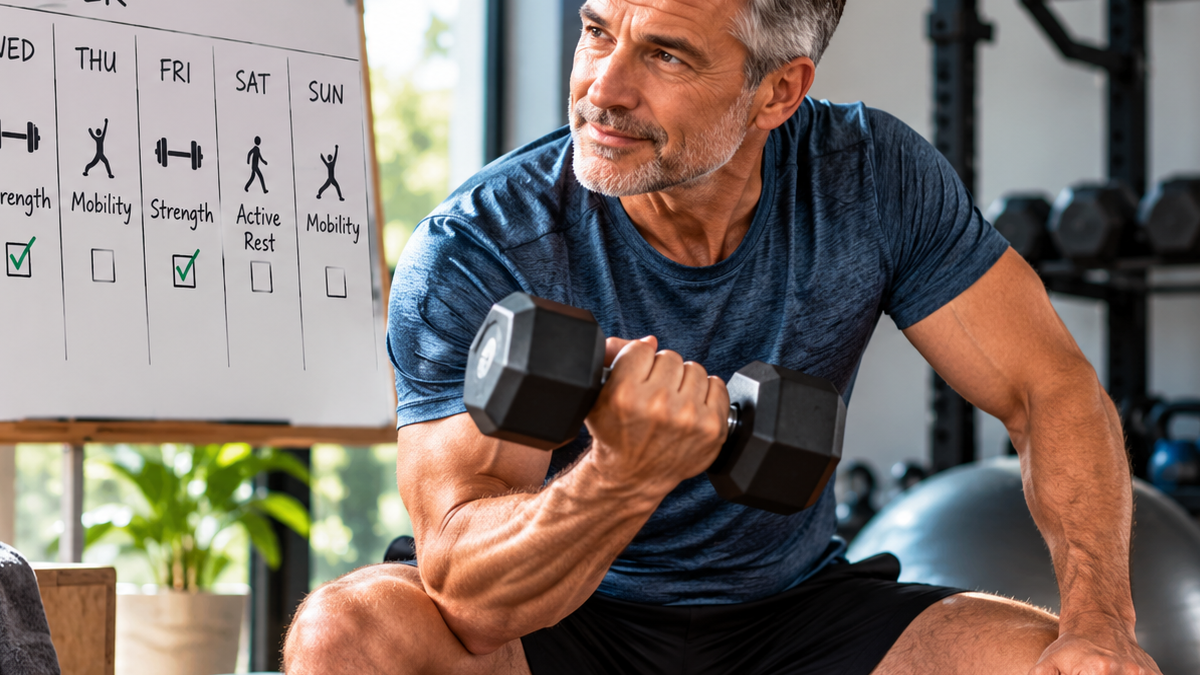
For many men, two or three full-body sessions per week is a practical range. You can walk, cycle or perform other lighter activity on additional days.
Read how often men over 50 should strength train for a deeper comparison of two-, three- and four-day schedules.
Common Bodyweight Training Mistakes After 50
- repeating the same easy variations forever
- doing only push-ups and squats while ignoring pulling
- assuming bodyweight means every movement is joint-friendly
- using speed instead of control to make workouts feel harder
- doing extremely high repetitions instead of progressing resistance
- copying advanced calisthenics movements before mastering basic versions
- training through persistent pain
When to Get Professional Guidance
Get individualized guidance if you have a recent surgery or injury, significant balance limitations, persistent joint or back pain, unexplained symptoms with exercise, or a medical condition that affects exercise tolerance.
A qualified exercise professional can also help you select the right progression if the beginner variation is too difficult or the basic variation is already too easy.
Join the TrueMontis Newsletter
Get practical guidance on strength, recovery, mobility, supplements, nutrition, and staying capable after 50.