What Good Posture Actually Means
Posture is the position your body uses for a task. There is no single alignment you must hold all day. Even healthy people naturally shift, lean, relax and change position.
A useful goal is not rigid alignment. It is having enough strength and mobility to move between positions comfortably and enough endurance that upright tasks do not feel unnecessarily tiring.
Why Posture Can Change After 50
Long periods of sitting, reduced strength, less movement variety, screen use, driving and previous injuries can all influence posture. Age can contribute, but habits and physical capacity often matter just as much.
Cleveland Clinic guidance emphasizes a combination of mobility and strengthening exercises for posture rather than simply forcing the body into one position. That is the approach used here.
Choose Posture Exercises by Your Situation
If You Work at a Desk
Prioritize rows, scapular retraction, chest mobility and upper-back rotation, then break up long sitting periods with short walks or standing movement.
If You Drive for Work
Long driving combines sitting with the arms held forward. Chest mobility, upper-back work, hip movement and regular stops to stand and walk are useful priorities.
If You Lift Weights
You may not need a separate “posture workout.” Make sure your program includes enough pulling, rowing, trunk work and full-range lower-body training to balance your pressing.
If You Do Not Exercise
Start with simple standing drills, rows with a light band, wall exercises and walking. Posture improves more reliably when overall activity rises, not when one corrective exercise is performed in isolation.
If You Feel Rounded Forward
Upper-back strength, chest mobility and shoulder control are practical targets. Avoid assuming that every rounded posture is a problem that must be “fixed”; some spinal shape is structural and varies normally between people.
If You Feel Stiff in the Morning
Use gentle movement first: shoulder circles, upper-back rotation, walking and easy hip movement. Do not force deep stretches immediately after getting out of bed.
1. Wall Alignment Drill
Stand with your back near a wall and use the wall as feedback rather than as a test you must pass. Gently bring the upper back and head toward the wall without forcing the lower back flat.
Hold for a few breaths, step away and notice the position. This is a posture-awareness drill, not proof that every part of your body must touch the wall.
2. Scapular Retraction
Stand or sit tall and gently draw the shoulder blades back and down without shrugging. Hold briefly, then relax.
This builds awareness of upper-back positioning and can be used during desk breaks, but it should eventually be paired with loaded pulling exercises.
3. Wall Angels
Stand with your back near a wall, elbows bent, and slide the arms upward only as far as you can comfortably control. Keep the movement smooth and avoid forcing the shoulders into a painful range.
If full wall angels are uncomfortable, use a smaller range or perform a simple wall slide.
4. Resistance Band Row
Anchor a resistance band securely in front of you and pull toward the ribs while keeping the torso steady. Rows strengthen the upper back and give the shoulder blades a loaded pulling task.
This is one of the most useful additions for men who spend much of the day with the arms forward at a keyboard or steering wheel.
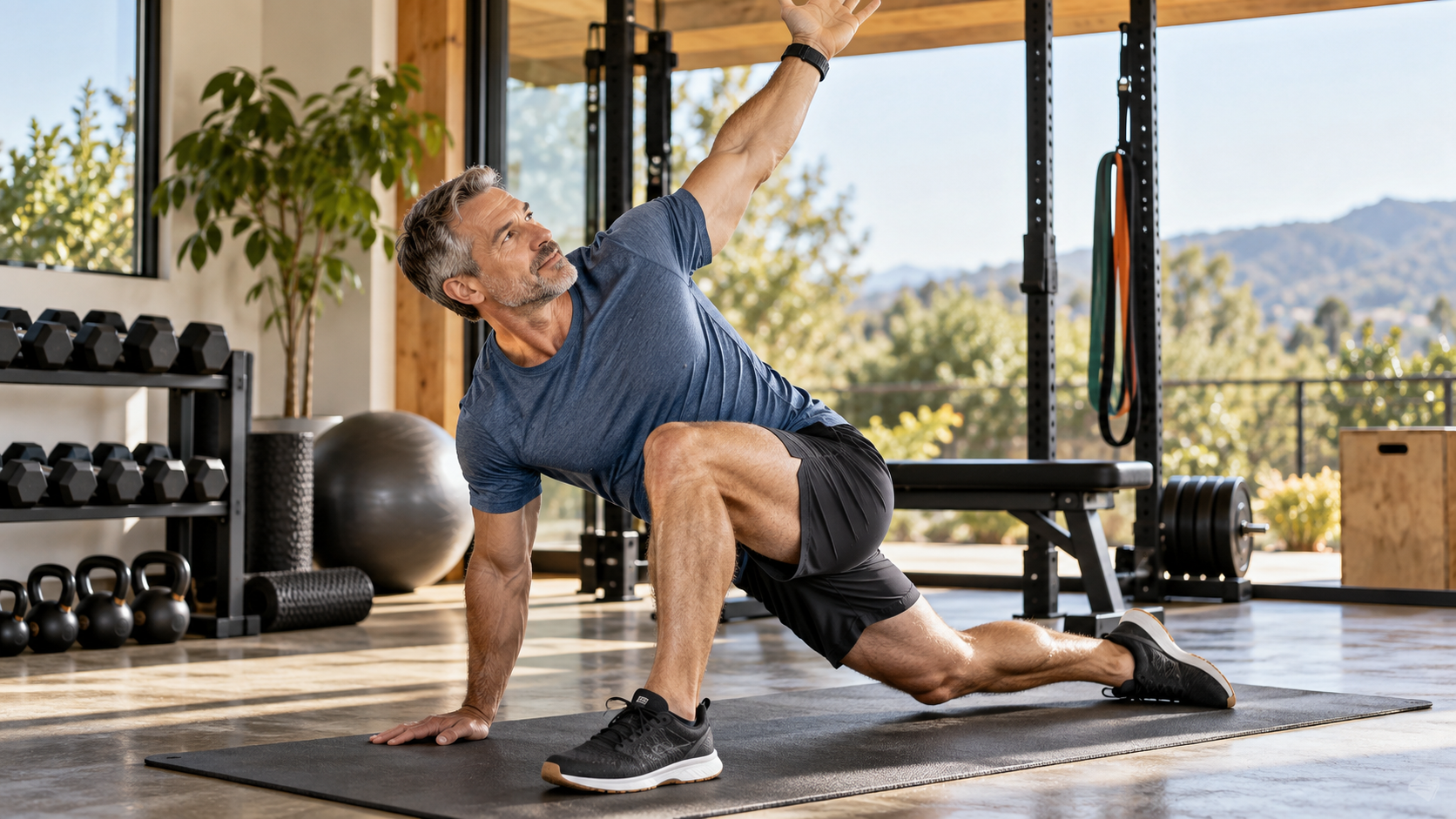
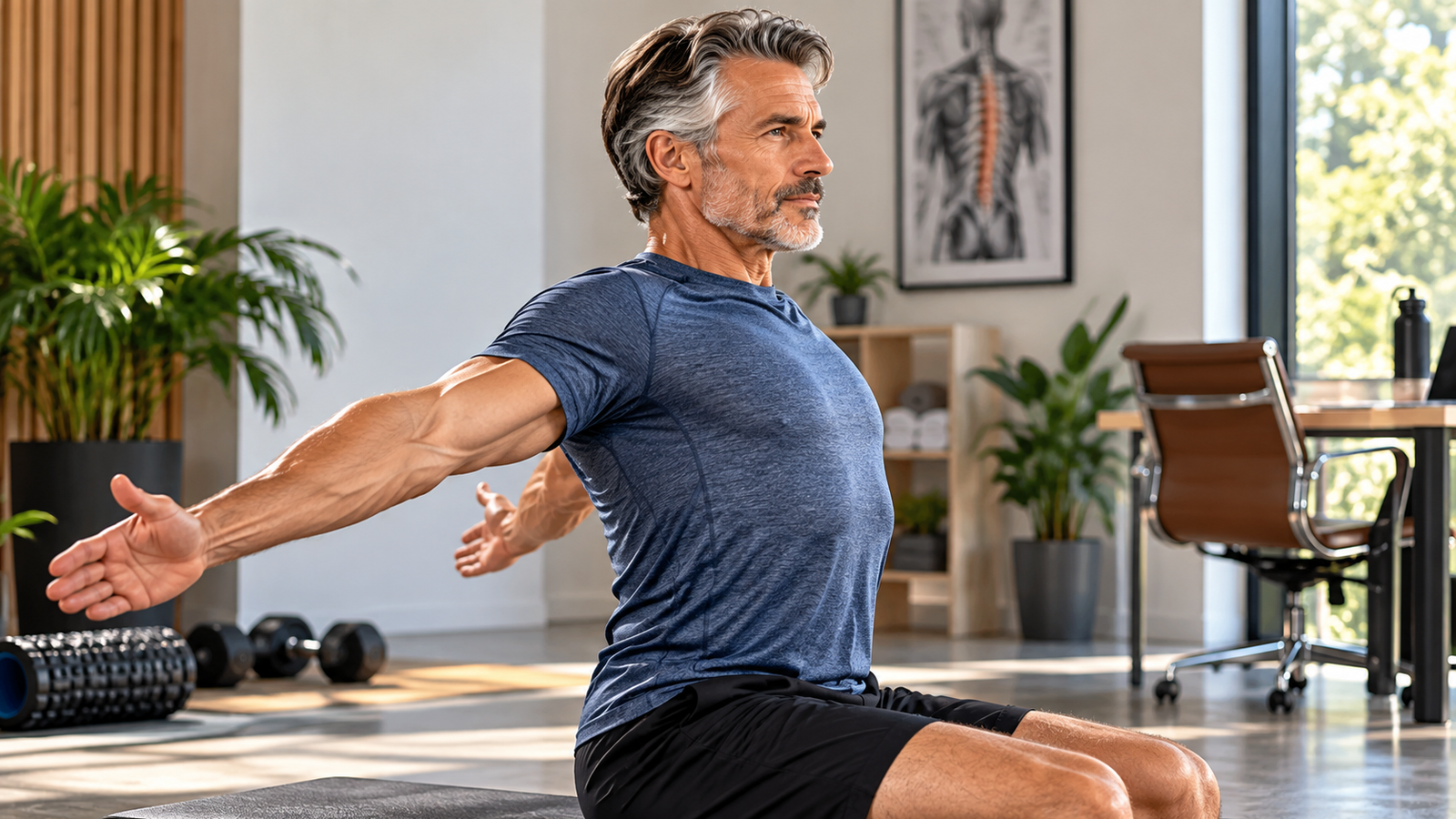
5. Upper-Back Rotation
Sit tall or work from hands and knees and rotate through the upper back in a controlled range. Keep the movement comfortable and avoid forcing the lower back.
Upper-back rotation is especially useful for men who sit, drive, golf or feel stiff when turning.
6. Chest Stretch
Place a forearm against a doorway and gently rotate away until you feel the chest and front of the shoulder lengthen. Keep the shoulder comfortable and do not force the arm behind the body.
If stretching is a larger priority, see our stretching guide for men over 50.
7. Dead Bug or Standing Core Brace
A dead bug trains trunk control while the arms and legs move. If getting to the floor is inconvenient, use a standing core brace with marching or a Pallof press instead.
Core training for posture is about resisting unwanted movement, not holding the stomach tight every minute of the day.
8. Glute Bridge
Lie on your back with knees bent and lift the hips by squeezing the glutes. This trains hip extension and gives the pelvis another source of support besides the lower back.
If floor work is difficult, use standing hip-hinge or sit-to-stand exercises instead.
A 10-Minute Posture Routine for Men Over 50
Try one or two rounds of:
- Wall alignment drill — 3 slow breaths
- Scapular retraction — 10 reps
- Wall slides — 8 reps
- Band rows — 10–15 reps
- Upper-back rotation — 6 reps per side
- Chest stretch — 30 seconds per side
- Dead bug or standing march — 6–10 reps per side
Use this as supplemental work. A full-body strength program remains more important than a long list of corrective drills.
Posture Exercises for Men Over 50 Who Sit at a Desk All Day
Do not wait until the end of the day to undo eight hours of sitting. Use two- to five-minute movement breaks throughout the day.
Stand, walk, perform several rows or scapular retractions, open the chest and rotate the upper back. The goal is movement variety, not maintaining one “perfect” desk posture.
Posture for Men Over 50 Who Drive a Lot
Adjust the seat so you can reach the wheel without pulling the shoulders forward excessively, and avoid sitting on a wallet or anything that shifts the pelvis.
On longer drives, stop when practical to stand and walk. Chest mobility, rows and hip movement are good complements once you are out of the vehicle.
Posture Exercises for Men Over 50 Who Lift Weights
If you already train, the solution may be program balance rather than extra corrective exercise. Include rows, carries, trunk work and adequate lower-body training instead of performing only bench presses and curls.
Our strength training after 50 guide explains how to structure the bigger program.
If You Do Not Exercise Regularly
Start with walking and a simple full-body strength routine rather than turning posture correction into a complicated project. A stronger, more active body usually has more options for sitting and standing comfortably.
You can begin at home with our bodyweight exercise guide.
What If You Have Back or Neck Discomfort?
Do not assume posture is the sole cause. Back and neck pain are influenced by many factors, including tissue sensitivity, activity, sleep, stress, previous injury and health conditions.
Gentle movement may help some people, but persistent pain, weakness, numbness, tingling, balance changes or symptoms that travel into an arm or leg deserve professional evaluation.
Daily Habits That Matter More Than One Posture Exercise
- change position regularly
- walk during the day
- strength train two or more days per week when appropriate
- set screens at a comfortable height
- avoid staying in one position for hours
- use chairs and workstations that let you vary posture
- sleep and recover well enough to support training
Common Posture Training Mistakes After 50
- trying to hold the chest up rigidly all day
- blaming every ache on posture
- doing stretches without strengthening the upper back and trunk
- using corrective drills instead of full-body exercise
- forcing wall angels or shoulder ranges that are painful
- ignoring symptoms that may need clinical evaluation
When to Get Professional Guidance
Seek professional evaluation for persistent or worsening pain, numbness, tingling, unexplained weakness, major loss of motion, balance changes, recent trauma, or noticeable spinal changes that concern you.
Join the TrueMontis Newsletter
Get practical guidance on strength, recovery, mobility, supplements, nutrition, and staying capable after 50.